스킵네비게이션
 이 누리집은 대한민국 공식 전자정부 누리집입니다.

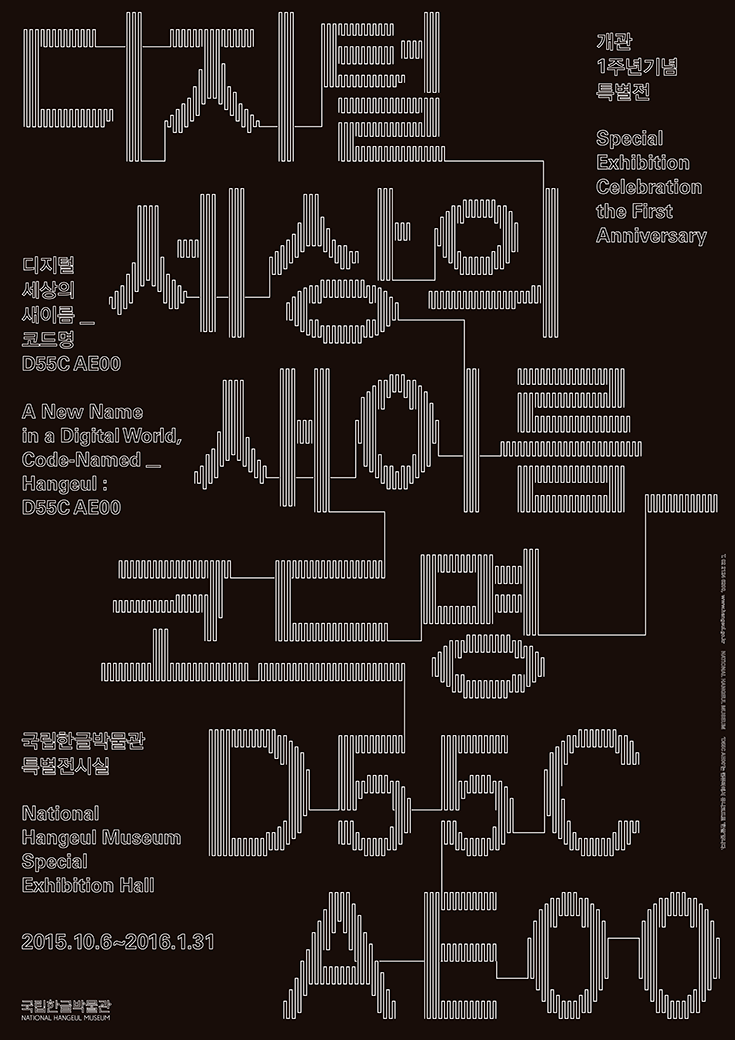
A New Name in the Digital World, Code-Named_Hangeul : D55C AE00
-
- 기간
- 2015.10.06.(화) ~ 2016.01.31.(일)
-
- 장소
- Special Exhibitions Hall
Introduction
Have you heard of ‘informatization’ or ‘Hangeul informatization’?
“Only those who adapt to the digital world would survive in a new generation.”
- ‘Unknown Light’, poet, 1982, Jo Byeong-hwa, from the first issue of an electronic newspaper
Today, in 2015, ‘mysterious unknown light’ became ‘everyday routine light’. It became so natural in our daily lives that we might even forget its existence.
Hangeul informatization made possible such a variety of things as Hangeul word processors, Hangeul keyboards, Korean language big data ‘Malmungchi(corpus)’, voice recognition and automated translation/interpretation. In particular, tracing, collecting, sorting and analyzing Korean language became possible through ‘malmungchi’.
The exhibition is presented in an effort to search for the endeavors to make ‘Hangeul informatization’ possible from 1980s up to now as well as the hidden stories about Hangeul informatization in everyday life.
We hope you have an opportunity to discover the true value of Hangeul in digitization.
Hangeul informatization made possible such a variety of things as Hangeul word processors, Hangeul keyboards, Korean language big data ‘Malmungchi(corpus)’, voice recognition and automated translation/interpretation. In particular, tracing, collecting, sorting and analyzing Korean language became possible through ‘malmungchi’.
The exhibition is presented in an effort to search for the endeavors to make ‘Hangeul informatization’ possible from 1980s up to now as well as the hidden stories about Hangeul informatization in everyday life.
We hope you have an opportunity to discover the true value of Hangeul in digitization.
Word processors
Father, I’ll print it out for you.
We are living in an era when various forms of documents can be written in word processors.
It was a common practice to write documents manually before word processors were developed.
‘Hangeul word processor version 1.0’ is the first of its kind developed by a high schooler in 1982. The monthly magazine, ‘My family’, was about various aspects of family lives written in word processor, ‘Hangeul 2.0’. Through these, we are going to have a look at the stories of the people who have tried to adapt to the world of computerized Hangeul.
It was a common practice to write documents manually before word processors were developed.
‘Hangeul word processor version 1.0’ is the first of its kind developed by a high schooler in 1982. The monthly magazine, ‘My family’, was about various aspects of family lives written in word processor, ‘Hangeul 2.0’. Through these, we are going to have a look at the stories of the people who have tried to adapt to the world of computerized Hangeul.
Keyboards
Would you like to try a different type of keyboard?
Today, we can choose the very keyboard which fits our own hands.
There were times in the past when we had to experience inconveniences because of the incompatible keyboards produced by different manufacturers.
Hangeul technology is introduced through various ways of input such as Hangeul keyboards, stenography keyboards and handwriting recognition.
There were times in the past when we had to experience inconveniences because of the incompatible keyboards produced by different manufacturers.
Hangeul technology is introduced through various ways of input such as Hangeul keyboards, stenography keyboards and handwriting recognition.
Codes
My name is 설므ㅣ(믜). (On some networks, a code does not exist for ‘믜’. So, ‘므ㅣ’ is typed instead.)
These days, it is possible to use without difficulty classical Hangeul and 11,172 syllables of modern Hangeul which represent all the possible combinations of Hangeul Jamo (consonants and vowels of the Korean alphabet). However, the use of these is not yet completely implemented on some networks even today resulting in some frustrations.
You will hear the stories about the efforts towards standardization of Hangeul codes and some inconveniences caused by the non-standardized codes.
You will hear the stories about the efforts towards standardization of Hangeul codes and some inconveniences caused by the non-standardized codes.
Fonts
Which font should I use?
We are living in times when we can choose the font we like with diverse devices according to the purposes, tastes and feelings. We used to live in the days when we had hardly any choice because there existed only a few fonts to choose from.
The process of transferring an old letter into a modern font is presented here, together with various types and terminology related to fonts.
The process of transferring an old letter into a modern font is presented here, together with various types and terminology related to fonts.
Corpus
‘I love you’ is ranked 7th on the list.
The language we use everyday for speaking, the language we use everyday for writing.
This is the era when Korean language big data is collected, sorted and analyzed in a systematic way. It could not have been made possible without the advent of computers.
Let us go through what malmungchi (Korean language big data) is and what it is used for.
This is the era when Korean language big data is collected, sorted and analyzed in a systematic way. It could not have been made possible without the advent of computers.
Let us go through what malmungchi (Korean language big data) is and what it is used for.
Photo


담당부서 : 전시운영과 (전화번호 : 02-2124-6324, 6327, 6335)
이전글
이전글이 없습니다.
하단메뉴 영역
 예약하기
예약하기


