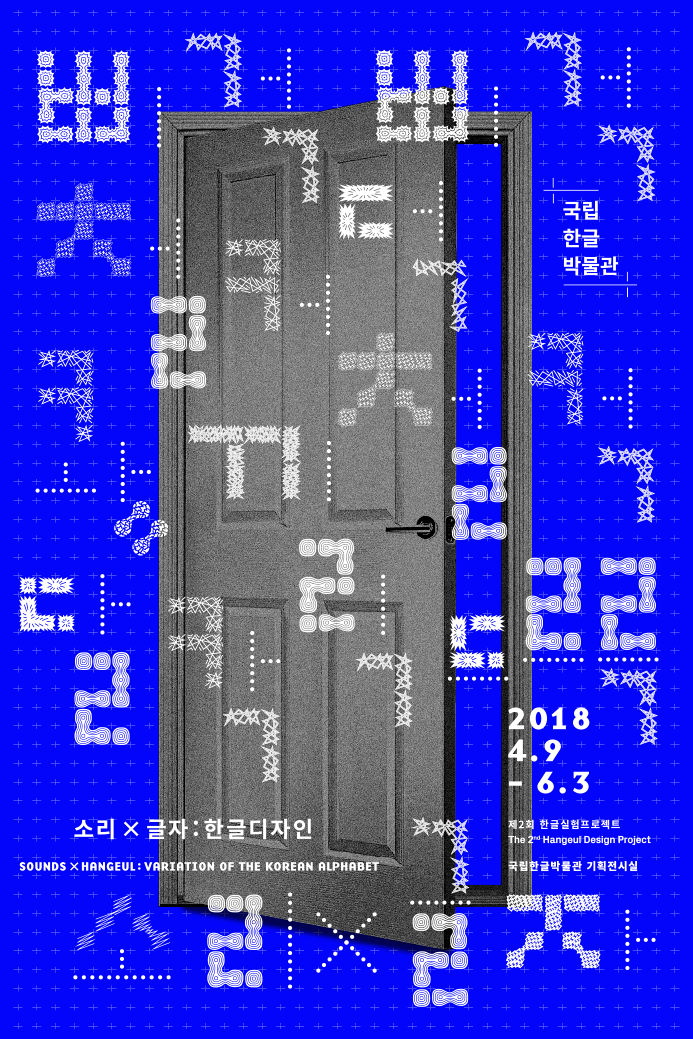
Since 2016, the National Hangeul Museum has annually organized the “Hangeul Design Project,” which seeks new values and prospects for Hangeul through a variety of experimental and challenging approaches. Drawing upon its research on the fundamental principles and aesthetics of the language, the Hangeul Design Project investigates previously unexplored themes or ideas in order to discover new possibilities for the language and Korean society as a whole.
In 2018, the theme of the Hangeul Design Project is sound. Like the Latin alphabet, Hangeul is a phonetic script, which means that the characters are visual representations of sounds (as opposed to the logograms of Chinese, which are written characters that represent words or phrases). Through various visualizations of Korean characters, this exhibition examines the aesthetics and expandability of Hangeul from a design perspective, ultimately highlighting Hangeul’s exceptional capacity for capturing the dynamic features of sound.
The first part of the exhibition—Hangeul Characters: Vessels of Sound—introduces the principles behind the creation of Hangeul, compares Hangeul to the Latin alphabet, and presents some incredible attempts to visualize sound. In the second part—Sounds × Characters × Design—nine artists and teams present striking and thought‒provoking works that creatively express the principles of Hangeul as vessels for sound. We hope that all of the featured artworks and experiences wil l help visitors better understand and appreciate the infinite potential of the remarkable aesthetics and experimental spirit of Hangeul.
Section 1 × Characters Shaped Like Vocal Organs
“The sounds of the Korean language are different from those of Chinese, and Chinese characters do not correspond to the sounds of the Korean language. Therefore, uneducated people are often unable to communicate or express their thoughts. I deeply regretted this situation, so I have created twentyeight charactes that can be easily learned by each and every person for convenient use in their daily lives.”
from “Preface by King Sejong,” Hunminjeongeum
(Proper Sounds for the Instruction of the People) Before King Sejong invented Hangeul, people spoke the Korean language, but they had no writing system to transcribe their oral language. To enable common people to better express themselves, King Sejong created Hangeul, which was intended to allow for maximum communication with minimal characters. For the utmost efficiency, King Sejong decided to model the characters on the vocal organs.
Hangeul Table Ware JEEHOON HA

This artwork manifests one of the most unique features of Hangeul: the arrangement of individual characters into syllabic blocks. Each tabletop is surrounded by a rim with four wooden channels where consonants and vowels can be shifted and aligned to form syllabic blocks. By using objects familiar from everyday life (i.e., tables), Ha Jeehoon takes a metaphorical approach to arouse our appreciation for the simple but sophisticated features of Hangeul. Rather than stacking four separate layers, the channels were created as a single unit with CNC manufacturing, for enhanced beauty and craftsmanship.
Hangeul Embracing the Sounds HYUNSUK KIM

People created written languages in order to conquer the limits of time and space. While the consonants of Hangeul were modeled on the vocal organs, the three primary vowels are based on the concept of the “Three Realms” (sky, earth, and humanity), a philosophy that also underlies the flexibility and expandability of the characters. Unlike some phonetic languages, in which each character corresponds to one syllable, Hangeul characters are combined to form syllables. The basic 8 letters were extended to 28 in all. Today, 4 of them being obsolete, 24 consonants and vowels of Hangeul are combined to make 11,172 syllabic blocks. This ingenious system allows for maximum expressions with a minimal number of characters. Hence, the phonetic script of Hangeul is like a “big bowl” that contains not only the sounds of nature (e.g., a gust of wind or the wail of a crane), but also the ideas, feelings, and culture of Korea.
Section 2 × Visualizing Sounds
The shape of each Hangeul character is meant to demonstrate the proper configuration of the vocal organs when making the respective sound of that character. The strokes also indicate whether the character is pronounced with a simple, aspirated, or tensed sound. In this way, each Hangeul character was designed to directly reveal its own pronunciation. The works in this section convey the aesthetic value embedded in Hangeul through diverse multi-sensorial experiences, exploring the transition between sound waves and written script in terms of movement, amplitude, flow, and shape.
Between the Lines NAMELESS

With just eight basic characters that can be modified and combined into 11,172 different syllabic blocks, Hangeul enables unparalleled freedom of expression. To represent this amazing efficiency and flexibility, the artist team of Nameless spatialized the eight basic characters, transforming two-dimensional strokes into three-dimensional objects. When placed next to each other, the characters change the shape of the empty space between them, and the endless variations of this space represent the fundamental value of Hangeul.
Movements to Create Letters VAKKI

Powered by electricity, this kinetic sculpture of colorful bars demonstrates how the Hangeul characters are formed. The bars of the modules move continuously to form the shapes of the characters “ㄴ,” “ㅇ,” and “ㅁ,” while the three parts of the sculpture show how the characters can be combined with one another. Many other Hangeul characters (ㄱ, ㄴ, ㄷ, ㄹ, ㅁ, ㅂ, ㅅ, ㅇ, ㅈ, ㅊ, ㅋ, ㅌ, ㅍ, ㅎ) are cleverly concealed in the artwork, offering a fun challenge for viewers.
Hangeul Portamento JAEWON SEOK

“Portamento” is a musical term that refers to sliding from one note to another. Applying this concept to Hangeul, this artwork delineates the shift in amplitude between consonants with different stresses, such as “ㄱ” and “ㅋ.” In Hangeul, there are five basic consonants, each of which can be either simple (e.g., “ㄱ”, aspirated (“ㅋ”), or tensed (“ㄲ”). This incredible efficiency, which allows users to denote an enormous array of different sounds with a few simple strokes, gives Hangeul the capacity to represent almost any conceivable sound in the world.
Wave Series—Wave ‘ㅣ’, Wave ‘-’, Wave ‘ㆍ’, Wave ‘ㅇ’ HYUN MIN WANG

Along with the Latin alphabet, Hangeul is one of the representative phonetic scripts in the world, combining visual simplicity with an efficient and systematic method for forming sounds through syllabic blocks. Korean speakers who see the character “ㄱ” wi
l l immediately think of the name for that character: “기역.” Pronouncing the name transforms the character into a vibration, which our ear then recognizes as a sound wave. The continuity between the visual and aural elements of Hangeul is memorably captured in Wave Series, which uses images of Hangeul characters to generate the i
l lusion of sound.
Mobi / Tongue ㄱ, ㄴ, ㄹ SUNG JANG

The form of Hangul’s consonant characters were inspired by the shapes of the human organs which create such sounds. The unique approach to investigating the shapes and the movements of our body such as lips and tongues take at the moment of vocalization of a sound led to the realization of the proximity between Hangul and people, and its designer’s viewpoint towards humanity. At the same time, it gave me an inspiring direction towards a new work. With Mobi module units which can express various structural forms, I composed three forms which depict human tongue, at the monent of pronouncing ㄱ[k,g], ㄴ[n], ㄹ[r,l].
Section 3 × Documenting Sounds
Without sounds, there are no written characters.
Sound Emo—Hangeul YUNTAE KIM

To highlight the combinability of Hangeul, this work uses three projectors to arrange characters into a human face that resembles an emoticon. Drawing from the five basic consonants, characters are projected to form red eyes, a green nose, and a blue mouth. Just as the three primary colors of light (i.e., red, green, and blue) can be combined to produce any color shade or tone, the individual characters of Hangeul can be variably arranged into syllabic blocks to represent a limitless range of sounds.
Section 4 × Collecting Sounds
As a phonetic script, Hangeul offers unlimited possibilities.
Urban Noise: L.A. JINYEOUL JUNG

During a two-week stay in Los Angeles, Jinyeoul Jung collected sounds from various parts of the city, which he then rendered as onomatopoeia (i.e., words that directly imitate sounds, such as “boom”). Revealing the industrial and multicultural nature of the city, the urban symphony includes the sounds of construction machinery, police and ambulance sirens, helicopters, people speaking various languages, beaches, forests, fountains, and pools (within a city that often suffers from water shortages). The noises also include artificial sounds that serve as signals for various processes, sensors, and network infrastructures.
For this project, rather than relying on preexisting onomatopoeia, Jung carefully examined each iteration of the collected sounds and expressed them anew. In this way, he alludes to the potential of Hangeul as a phonetic script capable of articulating an infinite range of sounds.
 이 누리집은 대한민국 공식 전자정부 누리집입니다.