Introduction
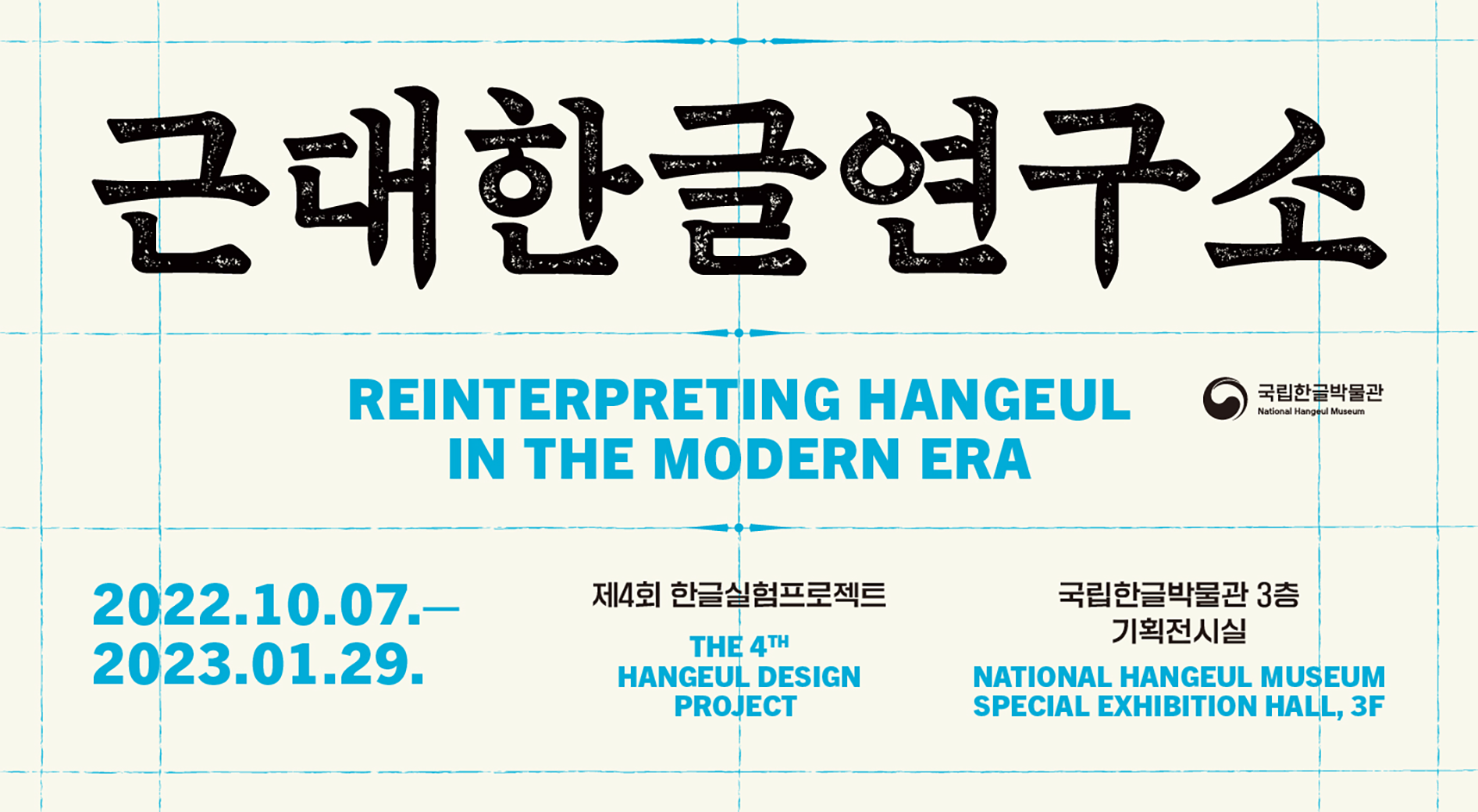
The Hangeul Design Project of the National Hangeul Museum reinterprets Hangeul from the design perspective to highlight the value of the Korean script as content for industry and the arts. Now in its fourth edition, this year’s Hangeul Design Project explores Hangeul's evolution during the modern era.
Following the opening of its ports in 1876, Korea was greatly transformed as new cultures and systems from other regions were introduced to the country. Under the influence of new cultural elements, traditions began to change and Hangeul similarly changed and developed. In 1894, King Gojong proclaimed that Hangeul be used for public documents and made it the official national script. The use of Hangeul expanded as it became the dominant writing system, which had previously been based on Chinese characters. Varied opinions on the proper use of Hangeul were presented, and study of the Korean language and script became more active. Moreover, common orthographic standards such as spelling and spacing were established. Western mechanical printing technology, which was introduced in the late nineteenth century, promoted the mass production of Hangeul materials. Attempts to keep up with the times led to diverse Hangeul publications such as newspapers, magazines, and literary works, with the titles and cover designs using Hangeul.
The participating artists in this exhibition reinterpreted the transformations in Hangeul that took place during the modern era from the present perspective. The results of the research conducted by twenty-three artists and design teams, covering the fields of visual arts, craft, fashion, music, and video, are being presented in four laboratories set up in the Special Exhibition Gallery of the National Hangeul Museum. We hope that visitors will explore the infinite potential and expandability of the Korean script.
1 Eastern and Western Languages Lab
Westerners who came to Korea after the opening of ports produced Korean dictionaries and textbooks to assist them in their missionary or diplomatic activities. In Europe, scholars who took an interest in Hangeul created tables of the Korean alphabet and presented them in their publications.
In Korea, Western languages, including the unfamiliar names of people and places, were introduced along with other cultures. Attempts were made to phonetically render English using Hangeul, as evidenced in Taeseo sinsa (1897), a book on Western history published by the Office of Education of the Korean Empire (Hakbu), or Ahakpyeon (1908), Ji Seok-yeong's new compilation of a children's book for learning Chinese characters that was written by Jeong Yak-yong during the Joseon Dynasty. Hangeul provided a means for the East and West, Koreans and foreigners, to understand each other.
2 Hangeul Style Lab
Diverse experiments on grouping and arranging Hangeul letters were constantly carried out during the modern era. Hangeul linguists established orthographic rules and substantial changes were made to the original method of writing vertically from top to bottom without spacing.
Ju Si-gyeong, a leading Korean linguist, promoted a method of writing horizontally from left to right and writing vowels and consonants linerarly without syllabic clustering. Sinjeong simsang sohak (1896), an elementary school Korean textbook, indicated slight pauses with a small circle (°) for easier reading. Spacing between words was introduced in the first issue of the newspaper Dongnip sinmun (1896). Moreover, various Hangeul types were produced to print books and newspapers.
3 Korean Folk Music Lab
Pansori, traditional narrative song, had only been passed down orally, but from the latter half of the Joseon Dynasty it began to be distributed in the form of woodblock-print or handwritten books. In the 1910s, pansori works were first published in the form of classical novels printed with metal type. The books came in diverse styles, and sometimes with different titles. For example, Chunhyang-jeon (The Tale of Chunhyang) was published under the title Okjunggain (A Beautiful Lady in Prison), Simcheongjeon (The Tale of Sim Cheong) as Gangsangnyeon (Lotus in the River), and Byeoljubu-jeon (The Tale of a Turtle) as Touigan (The Rabbit’s Liver). Pansori works were also presented in the form of illustrated plays. As Korean vocal music that had only been transmitted orally became widespread thanks to Hangeul metal-type printing, it was further developed in richer, diverse forms.
4 Hangeul Publishing Lab
New printing technology introduced in the late nineteenth century prompted the appearance of diverse publications, such as newspapers, magazines, and books, further fueling the spread of Hangeul. Hangeul publications that were mass-produced at low cost emerged as a new force in popular culture.
Various types of newspapers were published, some featuring both Hangeul and Chinese characters and others using only Hangeul, reaching a broad readership. Magazines and literary books caught readers' attention with distinct titles and cover illustrations utilizing Hangeul. Paperbacks called ttakjibon, or guhwaljabon, were hugely popular for their easy sentences, large text, interesting content, and moderate price, and further contributed to the spread of Hangeul.
 이 누리집은 대한민국 공식 전자정부 누리집입니다.